

Kiosks as Urban Service Points
Why kiosk design belongs in the concept stage — not the procurement list.
A kiosk is not just a box.
Walk through almost any city and you will pass a dozen kiosks without registering a single one. A ticketing booth at a tram stop. An information point in a square. A small retail unit beside a station entrance. A check-in counter at a campus gate. A service window in a hospital courtyard. Each one is a box — and we have been trained to see it as nothing more than a box.
But a public space kiosk is one of the most concentrated pieces of urban experience a person ever touches. It is where someone asks a stranger for directions, buys the thing they forgot, collects a parcel, checks in, reports a problem, or simply works out where they are. In a few square metres, a city makes a quiet promise: we thought about you being here.
When that promise is designed, the kiosk becomes an urban service point — a place of service, visibility, identity and interaction. When it is not, it becomes street furniture in the worst sense: an object dropped into space, facing the wrong way, speaking a different language, connected to nothing.
This is the difference between a space that is furnished and a space that is designed. The kiosk is where that difference shows most clearly.
At Urbaniture, this thinking comes from built work — including the Istanbul Kiosk, developed for tram stops and municipal service points across Istanbul’s metropolitan transit network.
01 · The ProblemThe kiosk is decided last
In most projects, the kiosk is not a design decision. It is a procurement line.
The pattern is familiar. Architecture is resolved. Landscape is approved. The masterplan is frozen. Then, late in the process, someone realises the site needs a ticketing point, an information booth, or a service unit. By then, there is no conceptual room left for it to belong anywhere.
So it is selected from a catalogue, placed wherever space remains, and disconnected from everything that shaped the project. In many cases, it is specified and ordered by a completely different team than the one that designed the public space in which it will live.
The results are predictable. A kiosk facing away from pedestrian flow. A service window at the wrong height. An information point outside natural sightlines. A booth blocking visibility instead of supporting it. A unit whose materials and proportions clash with their surroundings.
These are not manufacturing failures. They are failures of timing.
There is a second issue. Because kiosks are treated as standalone objects, they rarely share a design language with benches, lighting, shelters or signage. A single public space ends up with multiple visual vocabularies within a few metres. Each element may work alone; together, they create noise.
That is what furnished looks like. Designed looks different.
02 · DiagnosisTypical failure patterns
If you start to look for them, you will see the same failure patterns repeating across cities and sectors.
The kiosk is positioned where there is physical room, not where people actually arrive. Most users see the back or the side of the box — not the point of service.
A security or monitoring kiosk sits directly in the line of sight it was meant to keep clear. Instead of increasing safety, it creates a blind spot.
Service windows are set to a generic height. Wheelchair users, children and older people find themselves stretching or leaning in a way that was never tested.
Because queueing space is not designed, a line of five people blocks a ramp, a stair or a door. The kiosk functions. The public space around it does not.
Materials, colours and proportions are imported from a catalogue that never saw the site. The kiosk does its job, but it reads as a foreign object inside a different project.
Within a year, cabling, AC units, added shelves and taped-on signage appear. None were planned; all are necessary. The kiosk becomes a collage of fixes.
None of these problems are solved by swapping one product for another. They are solved by changing when and how the kiosk enters the project conversation.
03 · The ReframeA service point, not a box
The moment you stop seeing a kiosk as an object and start seeing it as an urban service point, every design decision shifts.
Function becomes human.
The question is not what the kiosk looks like, but what happens in front of it. A person arrives with a need and leaves with that need met or unmet. Height, orientation, legibility and comfort should all support that exchange. The seconds spent in front of a kiosk are short — but they repeat thousands of times a day. Together, they become part of how a place feels to live in.
Visibility works both ways.
A well-designed service point allows the operator to see out and the public to see in. Large transparent surfaces are not a styling choice; they are what makes the kiosk feel present and safe rather than closed and opaque. Presence replaces surveillance.
Identity becomes concentrated.
A kiosk is often the smallest built object in a public space and the one people get physically closest to. That proximity makes it a powerful carrier of identity — municipal, institutional or commercial. Designed with care, it communicates what the people responsible for this space think of the people using it. Designed without care, it communicates the same thing in the opposite direction.
Integration matters.
A service point should never arrive as a foreign object. Its materials, proportions and design language should belong to the same family as the seating, shelters, lighting and wayfinding around it. This is the core of designing human-scale urban systems rather than scattering individual products across a site. This is also where modular kiosk design matters most: a modular system lets one coherent language adapt across many functions and sites, so that the kiosk at a transit stop and the service point at a campus gate become cousins rather than strangers.
The interior matters.
A service point is also a workplace. Someone spends their shift inside it — often a long one, in heat or cold, watching, helping, selling, reassuring. The quality of service delivered outside rarely exceeds the quality of space provided inside.
04 · ContextSame typology, different life
The same physical typology behaves differently in different contexts. Thinking through those contexts is part of what makes a kiosk a service point rather than a box.
At a tram or metro stop, people arrive in pulses. They are usually in motion, often in a hurry, sometimes in unfamiliar territory. Their needs are simple but high-stakes: the right ticket, the right platform, reassurance that they are in the right place.
Here the kiosk is a service amplifier. Its position should support the choreography of waiting and boarding — facing the main approach, not an empty corner. It should let the operator see platform, tracks and approaches clearly, and signal through light and transparency that the stop is active and watched over, especially at night.
On a university or corporate campus, kiosks often sit at gates or central nodes. The user mix is richer: students, staff, suppliers, couriers, visitors. The kiosk may combine visitor registration, access control, information and parcel handling in a single footprint.
In this setting, the kiosk becomes the physical user interface of the campus system. It should carry campus identity calmly — not branded like a retail outlet — belong to the same landscape grammar as seating, shade, planting and wayfinding, and remain flexible enough to absorb future shifts in policy or technology without replacement.
In a hospital or clinic, people often arrive in distress — ill, worried, tired, managing complex logistics. Clarity, safety and human contact matter more here than almost anywhere else.
A kiosk here might be a security point, a reception booth, a triage gate, or all three. Designed as a box, it risks feeling like a barrier at exactly the moment people most need support. Designed as a service point, it uses transparency and light to feel open and approachable day and night, gives the person inside the sightlines and tools to respond quickly, and helps make a complex environment legible — one interaction at a time.
From Box to Service Point: The Istanbul Kiosk
None of this is theory for us. We have designed it, built it, and watched it work at metropolitan scale in Istanbul.
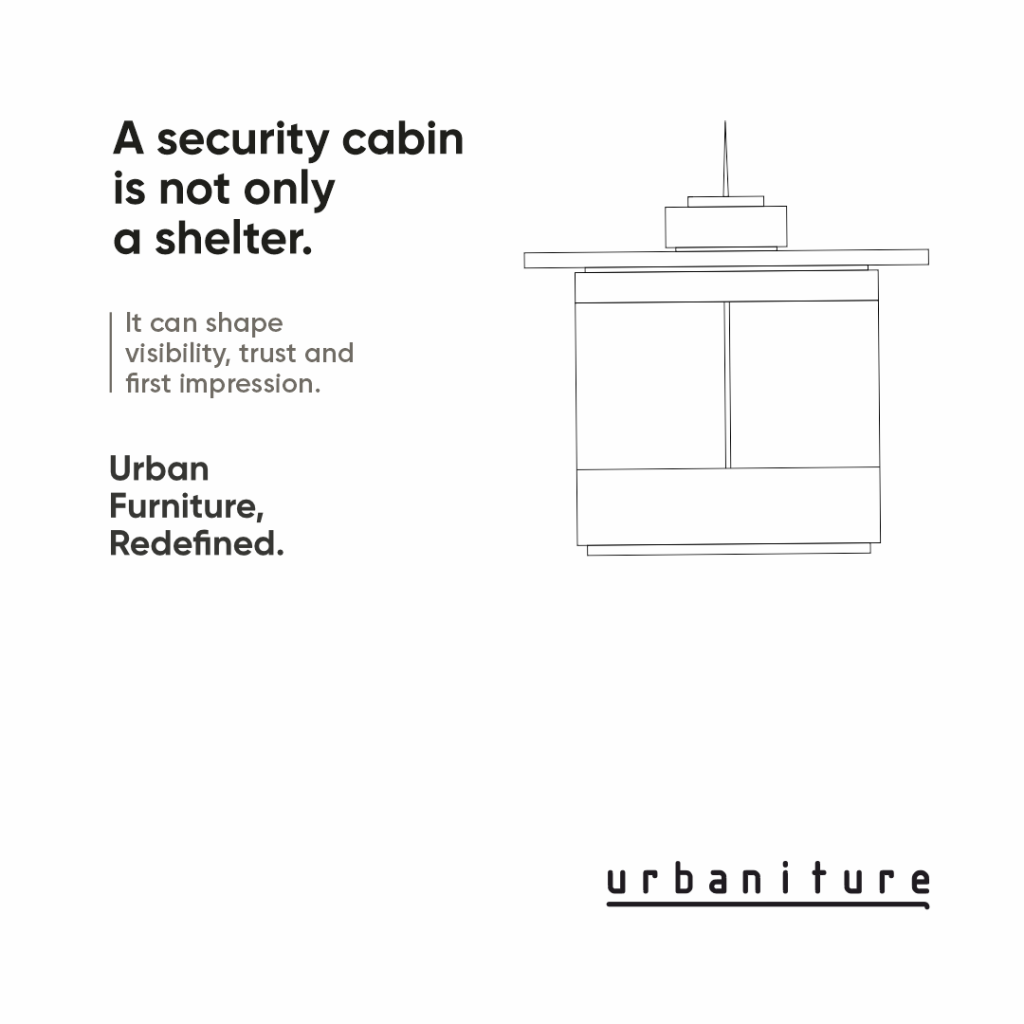
The Istanbul Kiosk was developed for the tram stops and municipal service network of Istanbul. The brief was deceptively simple — a functional unit for municipal service and security at busy transit points — and the easy answer would have been exactly the box that brief seems to ask for. We designed a service point instead.
Large glass surfaces give the kiosk genuine environmental visibility in both directions. Personnel inside can monitor the stop and its surroundings clearly, and the public can see at a glance that the point is staffed and attended. This visibility turns a control unit into a point of trust rather than surveillance — people read presence, not suspicion.
Inside, the kiosk is organised as a real workspace: comfortable, well-equipped, designed for someone who will spend hours there rather than minutes. Outside, it carries municipal identity clearly but without aggression — a service the city offers, not a checkpoint the city imposes.
What matters most is that this was never a single object. The design was conceived to be replicated across the metropolitan transit network — one coherent language deployed at scale, stop after stop, so that a rider in one part of the city meets the same designed promise as a rider in another.
Built on 23 years of public-space design practice, Urbaniture treats these small functional units as places where public life actually happens. A single kiosk can be well designed. A system of kiosks shapes how an entire city experiences the act of waiting, asking and being looked after in public.
05 · Before You Place ItWhat to ask first
A few early questions prevent most late-stage compromise:
- What is the kiosk genuinely for, in terms of the human exchange it hosts?
- Which direction should it face, based on how people actually move — not where there happens to be space?
- Can the person inside see out, and can the public see in?
- Does it speak the same design language as the benches, shelters, lighting and signage around it?
- Could it be part of a modular system that serves the next site, and the one after, rather than a one-off?
These questions are almost free at concept stage. They are expensive — sometimes impossible — to answer once the space is built and the kiosk is the last item on a procurement list.
06 · For Project TeamsA practical checklist
Service and capacity
- How many interactions per day will this kiosk handle?
- How long does a typical interaction take?
- Are there peak times that require different layouts or staffing?
Flows and queues
- Where do people naturally come from, and where do they go next?
- If a queue of ten forms, what does it block?
- Can the kiosk help structure the queue instead of fighting it?
Visibility and safety
- Which areas must be visible from inside at all times?
- At night, does the kiosk make the space feel watched over or deserted?
- Does the kiosk itself create any blind spots?
Interior workspace
- How many people work inside, and for how long?
- Is there room for equipment and movement without improvisation?
- Could you work a full shift here with dignity?
Maintenance and evolution
- How will technicians reach and service the unit without disrupting public space?
- If the function changes in three years, can the structure adapt?
07 · The ShiftBring the kiosk into the concept, not the catalogue
The single most useful change any project can make is to move the kiosk decision earlier.
A kiosk considered while the concept is still forming can shape sightlines, anchor circulation, define a service strategy and carry a project’s identity. A kiosk considered at the end can only occupy leftover space.
The cost of moving that decision forward is negligible. The value it unlocks is the whole distance between a space that works and a space that has merely been furnished.
Furnished is not designed.
Planning a public, campus, hospitality, residential or shared outdoor space? Bring Urbaniture in early — before the system decisions become procurement decisions.
Discuss your next project with Urbaniture →
Urban Furniture, Redefined.