

Security Cabins as Public Trust Points
How small security structures shape visibility, trust and first impression.
A security cabin is not only a shelter.
In public and shared spaces, security cabin design does more than house personnel. It shapes how people enter a place. It influences how visible help feels. It affects whether the first encounter feels calm, clear, defensive or hostile.
This small structure is often one of the first physical touchpoints people meet when they approach a campus, transport stop, municipal service area, residential development, business park, hospital, cultural building or public institution.
That makes it more than a technical unit.
A point of orientation.
A point of visibility.
A point of trust.
Too often, security cabins are treated as boxes to be placed at the end of a project. A space is designed, circulation is fixed, the landscape is developed, and only then does someone ask where the security cabin should go.
By then, it can only be added. Not designed.
At Urbaniture, we see this differently. Security cabins belong to the human-scale systems of public space. They should be considered early, alongside movement, visibility, identity, user experience and the everyday working conditions of the people inside them.
A security cabin should not only protect. It should make security feel visible, human and designed.
01 · The ProblemLate-stage security cabins
When a security cabin is selected too late, it usually becomes a compromise.
It may be technically functional, but spatially disconnected. It may provide shelter, but weaken the entrance experience. It may mark a control point, but make the environment feel more defensive than welcoming.
This is the familiar problem of late-stage procurement. A cabin is chosen from a catalogue. It is placed where there is still space. Its form, material, transparency, roofline, signage and lighting rarely belong to the wider architectural or landscape language. The result is a small object that solves one operational need while creating several spatial problems.
The cabin sits in the line of sight it was meant to keep clear, creating a blind spot instead of supervision.
Placed where space remained, the cabin cuts across the natural path people take to enter.
Form and material belong to a catalogue, not the site. The entrance reads as defensive rather than welcoming.
A disconnected unit makes a finished entrance look unresolved — as if arrival was never fully designed.
Designed only from outside, the cabin becomes a difficult place to spend a long shift.
The first touchpoint communicates how much care the place gives to the moment of arrival.
None of this necessarily happens because of poor intentions. It happens because of sequence. When security is added late, it often becomes a box. When it is designed early, it becomes part of the public-space system.
02 · The ReframeFrom guard booth to public trust point
The language we use matters. When we call something a guard booth, we usually think of a small enclosed unit. When we call it a security cabin, we think of a technical shelter. Both terms are useful, but they do not fully describe the role this structure plays in public space.
We prefer to think of it as a public trust point — a small human-scale structure that supports four things at once: presence, visibility, orientation and confidence.
It helps people understand where to enter. It shows where help can be found. It gives security personnel a clear view of the environment. It allows visitors, passengers, residents, students or employees to feel that the place is managed without making it feel hostile.
Security does not need to disappear. But it also does not need to dominate. Good security cabin design creates presence without aggression. It supports safety without turning the entrance into a barrier. A public trust point is not about making security invisible. It is about making security legible.
03 · VisibilityVisibility without aggression
Visibility is one of the most important design decisions in a security cabin. A cabin with poor visibility limits the ability of personnel to monitor the surrounding environment. It can also make the public feel uncertain — unsure whether the cabin is occupied, where to ask for help, or whether the structure is part of the space or simply an obstacle within it.
Transparency changes this relationship. Large glass surfaces allow personnel to see and be seen. This mutual visibility creates a calmer form of presence: the person inside understands what is happening outside, and the person outside understands that help, guidance or supervision is available.
But transparency alone is not enough. The proportions of the cabin matter. The height of the glazing matters. The position of the entrance, the depth of the roof, the relationship between opaque and transparent surfaces, the lighting strategy, the placement of signage and internal equipment — all of it matters.
A fully transparent box can feel exposed and uncomfortable for personnel. A fully closed cabin can feel defensive and unapproachable. The right balance allows the cabin to work both as a secure workplace and as a clear public interface. Security should be visible without feeling aggressive.
04 · The InteriorA security cabin is also a workplace
One of the most common mistakes in security cabin design is to treat the structure only from the outside. But a security cabin is also a workplace.
The person inside may spend many hours there across a shift, often alone and often in difficult weather. They may need to monitor movement, speak with visitors, store personal items, use equipment, control access, respond to incidents, complete administrative tasks and remain alert throughout the day. This means the interior is not secondary. It is central.
Sightlines matter. Seating matters. Storage matters. Ventilation matters. Lighting matters. Cable management matters. Access matters. Surface durability matters. The placement of screens, drawers, switches, communication tools and documents matters.
A cabin that looks clean from the outside but is difficult to work in has not been fully designed. Human-scale design must consider both sides of the glass: the person approaching the structure and the person working inside it.
When the interior is poorly planned, personnel adapt the space themselves. Extra chairs appear. Cables become visible. Equipment is placed wherever it fits. Storage overflows. The cabin slowly loses the clarity it had on day one. A good security cabin does not only shelter personnel. It supports their work.
05 · IdentityIdentity and first impression
A security cabin often represents something larger than itself — a municipality, a campus, a transport authority, a hospital, a residential development, a cultural institution, a hospitality environment, a business park. This means it carries identity whether the project team intends it or not.
For many people, the security point is part of the first impression. It tells them how the place wants to be entered, how controlled it feels, how easy it is to ask for help, and how much care has been given to the small but important moments of arrival.
A generic cabin says the entrance was solved as a technical requirement. A designed cabin says the first point of contact matters.
This does not mean every security cabin should be visually loud. In many contexts, the best solution is quiet, precise and integrated. The cabin should carry identity through proportion, material, detail, transparency, lighting and placement — not through unnecessary decoration. The aim is not to make a security cabin look like a landmark. The aim is to make it belong.
06 · LifecycleModularity and long-term maintenance
Public-space structures live long, hard lives. They are exposed to weather, changing use patterns, vandalism risk, technology updates and evolving operational needs. A security cabin designed only for first-day appearance can quickly become obsolete, cluttered or difficult to maintain.
This is why modularity matters. Glazing, panels, cladding, lighting, interior fittings and service access should be considered as parts of a long-term system. Components should be repairable, replaceable and adaptable without forcing the entire structure to be rebuilt.
The same applies to wiring, data, ventilation and future security equipment. If these needs are not planned from the beginning, they appear later as visible add-ons: exposed cables, extra boxes, temporary fixtures and improvised storage.
A trust point that remains clean, operational and up to date reinforces confidence. One that visibly deteriorates sends the opposite signal. Durability and ease of service are not separate from design quality. They are part of it.
Security Kiosk: a compact structure with a public role
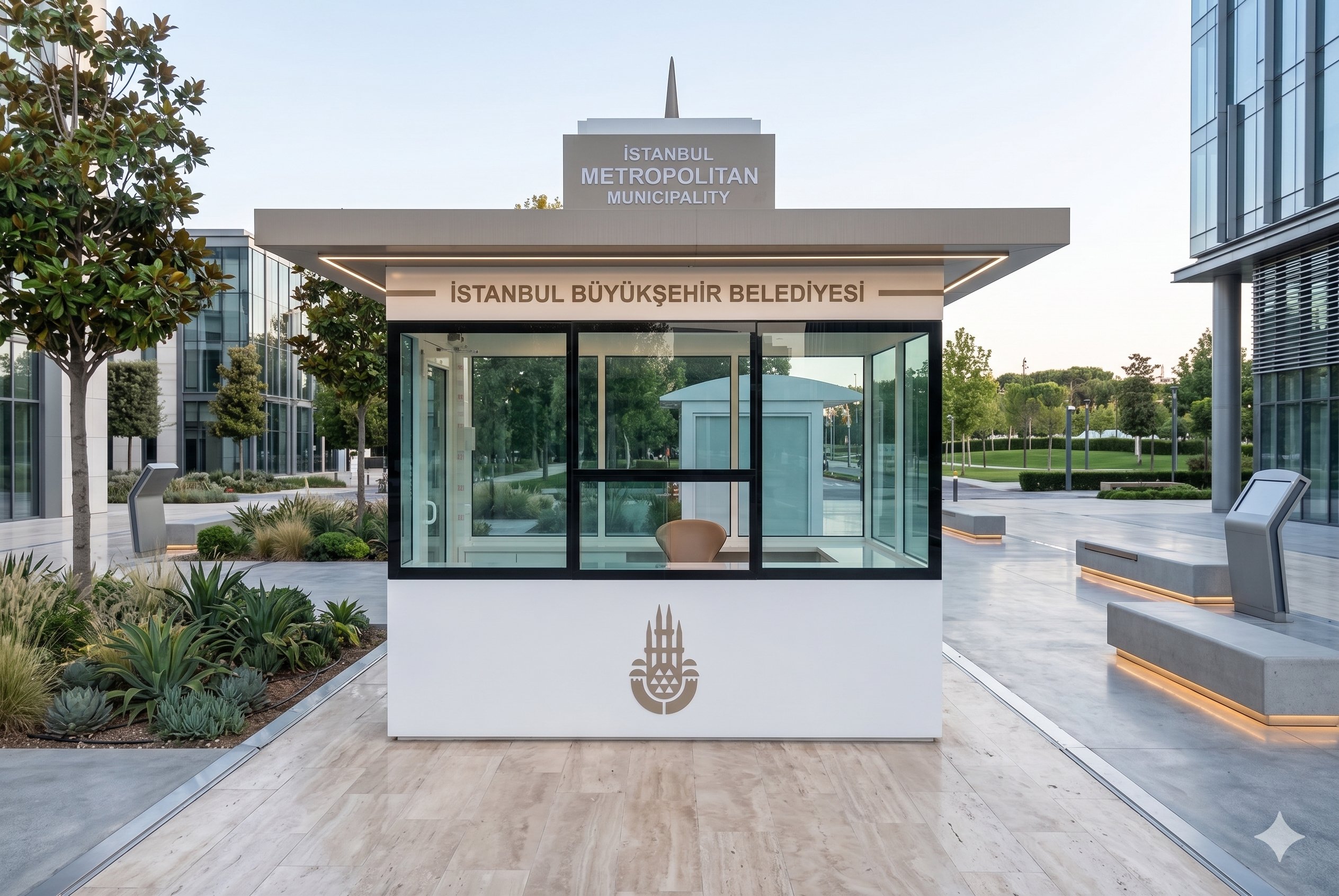
Urbaniture’s Security Kiosk was developed with this perspective: a compact security structure designed as part of a public-space system rather than as an afterthought. It shows how a small structure can become more than a guard booth.
Large glazing panels on the public-facing sides are placed to support mutual visibility. Personnel can read pedestrian movement and the threshold area without leaving the workspace. At the same time, people approaching the kiosk can understand that help, guidance and supervision are present.
The glazing height and façade rhythm create openness without exposing the entire interior. Solid surfaces at working height provide room for equipment, documents and privacy. Transparent surfaces above them maintain visual connection with the surroundings.
Inside, the plan is organised around efficient work. A compact layout allows one person to monitor, speak with visitors and manage daily security tasks with minimal unnecessary movement. Work surfaces, storage and equipment zones are treated as part of the design, not as later additions. This keeps the cabin from becoming a collection of screens, cables, chairs and improvised storage after installation.
Externally, the kiosk uses a calm institutional language. Clear lines, neutral cladding and a readable signage zone allow the structure to carry municipal, campus or private-operator identity without becoming visually aggressive. Its compact form reads closer to a small pavilion than a fortification.
It does not hide security. It does not turn security into a threat. It makes security legible as part of the public environment. What it demonstrates is not a single feature, but a way of thinking: small structures deserve the same design attention as any element people meet at human scale.
Built on 23 years of public-space design practice, Urbaniture treats these small functional units as places where public life actually happens. Security works better when it feels like presence, not threat.
07 · ContextWhere this approach matters
Security cabin design matters wherever people enter, wait, ask, pass, check in or seek help.
At stops and stations, movement, visibility and public confidence are critical. The cabin should read as an active, attended presence — especially at night.
At campus entrances, security should support orientation without making the environment feel closed. It belongs to the same grammar as seating, planting and wayfinding.
In municipal service areas, the public should feel guided rather than controlled. The cabin signals a service the city offers, not a checkpoint it imposes.
In residential developments, the first impression of safety affects everyday trust. Calm presence matters more than defensive gestures.
In hospitals and healthcare sites, clarity, calmness and accessibility are essential at exactly the moment people are most under stress.
These contexts differ in scale, audience and purpose. What they share is a moment of arrival. The security cabin sits at the threshold, where impressions form quickly and where the difference between welcome and wariness is set early.
The question is not only where to place it. The question is what role it should play.
08 · The ShiftBring security cabin design into the project earlier
Security cabins should be discussed when the public-space logic is still being shaped — not after the procurement list is written.
When the security point is considered early, it can support circulation, visibility, identity, personnel comfort, safety perception and architectural coherence. It can work with the landscape rather than against it. It can align with the entrance sequence. It can become part of the material and visual language of the project. When it is considered late, it can only fill a gap.
This is the broader idea behind Urbaniture’s work. We design human-scale urban systems for public and shared spaces — from urban furniture to kiosks, security cabins, modular service points and multifunctional outdoor structures. These elements should not be isolated objects selected after the main design work is finished. They should be part of how the public-space system is conceived.
Designed as a standalone object, a security cabin fills a need. Designed as part of a system, it improves the public-space experience.
Furnished is not designed.
Planning a public, campus, hospitality, residential or shared outdoor space? Urbaniture designs security cabins, kiosks and modular service points as part of coherent human-scale systems. Bring security cabin design into your project from the start.
Urban Furniture, Redefined.