


Why benches, fountains, shade and planting now belong at the centre of climate adaptation.
Much of the contemporary city was not designed for the thermal conditions it increasingly has to accommodate. Hard surfaces absorb and store solar energy throughout the day. Dense urban form can restrict airflow. Limited vegetation reduces both shade and evapotranspiration. At night, paved surfaces and building masses release accumulated heat slowly, extending thermal stress long after sunset.
The result is not simply a hotter city. It is a city in which ordinary public life becomes harder: walking to the shops, waiting for public transport, sitting with a friend, accompanying a child to a playground, cycling across a neighbourhood or resting halfway home.
Climate adaptation is usually discussed at the scale of districts, buildings, green corridors and major infrastructure. Those strategies are essential. But people experience heat at a much smaller scale — through the surfaces they touch, the paths they walk, the objects they sit on, the structures they stand beneath and the availability of shade, water and rest along the way.
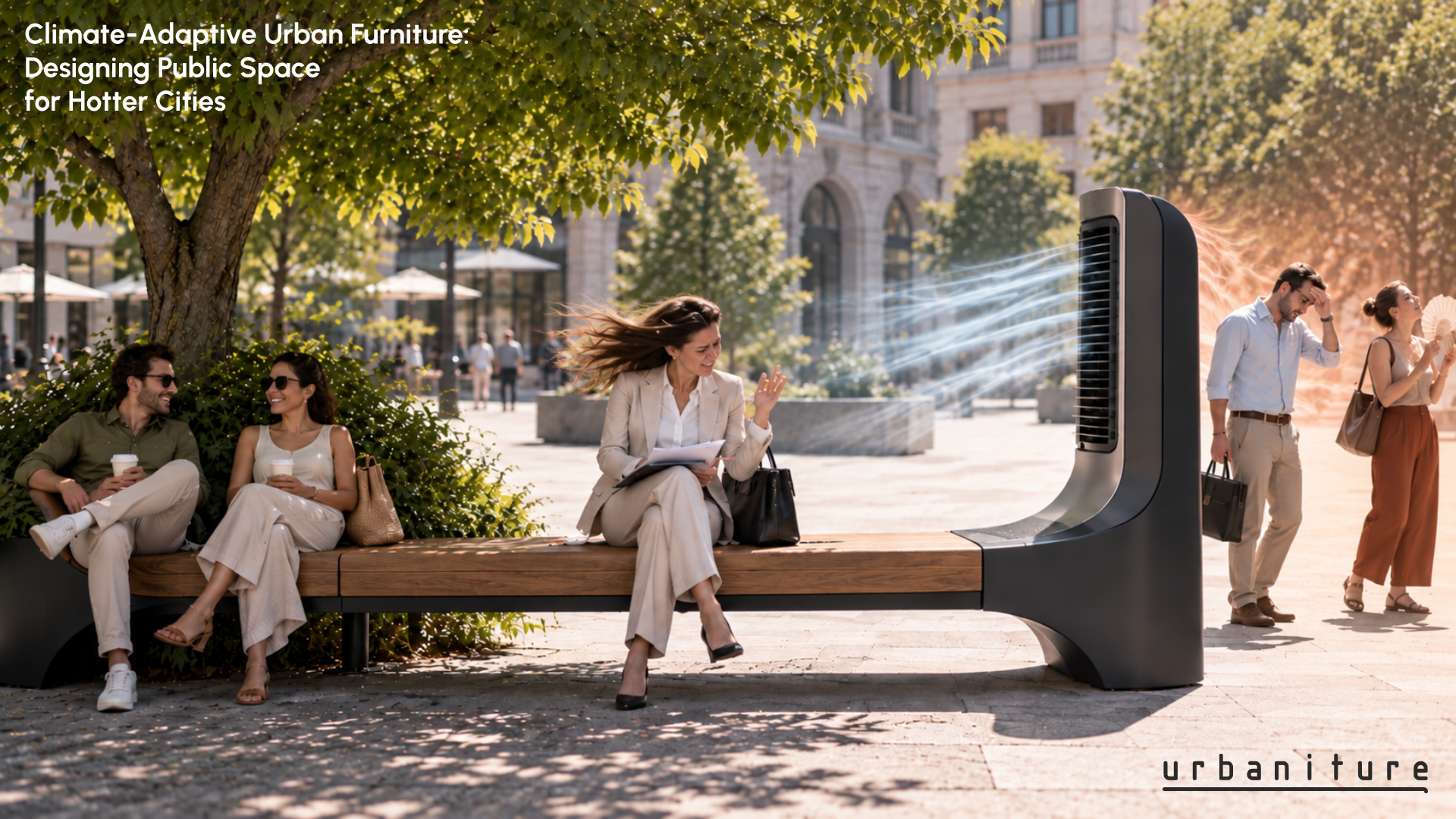
This gives climate-adaptive urban furniture a new role. A bench is no longer only a place to sit, a canopy no longer only a shelter, a planter no longer only decoration and a drinking fountain no longer merely an amenity. Together, these elements can form the human-scale layer of a city’s climate infrastructure.
Heat changes the urban furniture design brief
Street furniture has traditionally been evaluated through familiar criteria: function, ergonomics, durability, aesthetics, cost, maintenance and resistance to intensive public use. All of these still matter. Heat adds another criterion: thermal performance.
A bench can be ergonomically correct and still be unusable because its surface becomes too hot to touch. A plaza can provide hundreds of seats on plan and almost nowhere comfortable to sit during the hottest hours. A transparent shelter can protect people from rain while simultaneously exposing them to intense solar radiation. In each case, the space remains physically accessible while becoming thermally inaccessible.
This shifts one of the most basic questions in urban furniture design. It is no longer enough to ask what people should be able to do in a place. We also need to ask:
Under what climatic conditions will they actually be able to do it?
That question moves urban furniture beyond object selection and into environmental performance.
Thermal comfort begins where people stop
Air temperature alone does not explain how heat is experienced outdoors. Direct solar radiation, heat emitted by surrounding surfaces, reflected radiation, humidity and wind all influence thermal comfort. This is why outdoor thermal research also considers mean radiant temperature (MRT) and human-centred indices such as the Universal Thermal Climate Index (UTCI) and Physiological Equivalent Temperature (PET).
For public-space design, one conclusion appears repeatedly: radiation — and therefore shade — matters enormously. Studies of outdoor thermal comfort show that moving from direct sun into effective shade can reduce perceived thermal stress by several degrees and, under hot clear-sky conditions, considerably more. Two people sitting only a few metres apart — one beneath a tree and one in full sun — can experience radically different thermal environments even though the measured air temperature is almost identical.
The same logic applies to the furniture itself because urban furniture is touched. People sit on it, lean against it and hold it with their hands, making surface temperature a direct design parameter.
A field study of common public-space materials under hot, dry summer conditions recorded sun-exposed metal seating surfaces above 60 °C during the afternoon. Under the measured conditions, these temperatures approached or exceeded relevant contact-burn risk thresholds for hot surfaces. Shade substantially reduced the temperatures of the measured materials — in some cases by around 16 °C.
These values should not be treated as universal numbers. Climate, solar exposure, colour, material thickness, geometry and surface finish all influence the outcome. The more useful design conclusion is that materials should be specified for the microclimate in which they will actually be used.
Durability alone is no longer enough.
Shade as a public service
The most effective heat-resilient bench may begin not with the bench itself, but with what is above it.
Shade has often been treated as an architectural or landscape feature that happens to accompany street furniture. In hotter public spaces, that relationship needs to become deliberate. Seating should be considered together with solar exposure. Waiting areas should respond to the path of the sun as well as pedestrian circulation. Public tables should be positioned according to when people are likely to use them and whether they remain comfortable through those periods.
Trees remain one of the most valuable sources of shade because their contribution extends beyond blocking direct solar radiation. They also support evapotranspiration, biodiversity, stormwater retention, habitat and spatial identity. Research examining street-tree effects on UTCI shows that tree canopy can meaningfully reduce heat stress on hot days, although performance varies with species, canopy density, street geometry and local climatic conditions.
But tree canopy cannot be created instantly everywhere. Young trees need time to mature. Underground utilities may limit planting. Structural slabs, transport infrastructure and heavily engineered plazas can constrain soil volume.
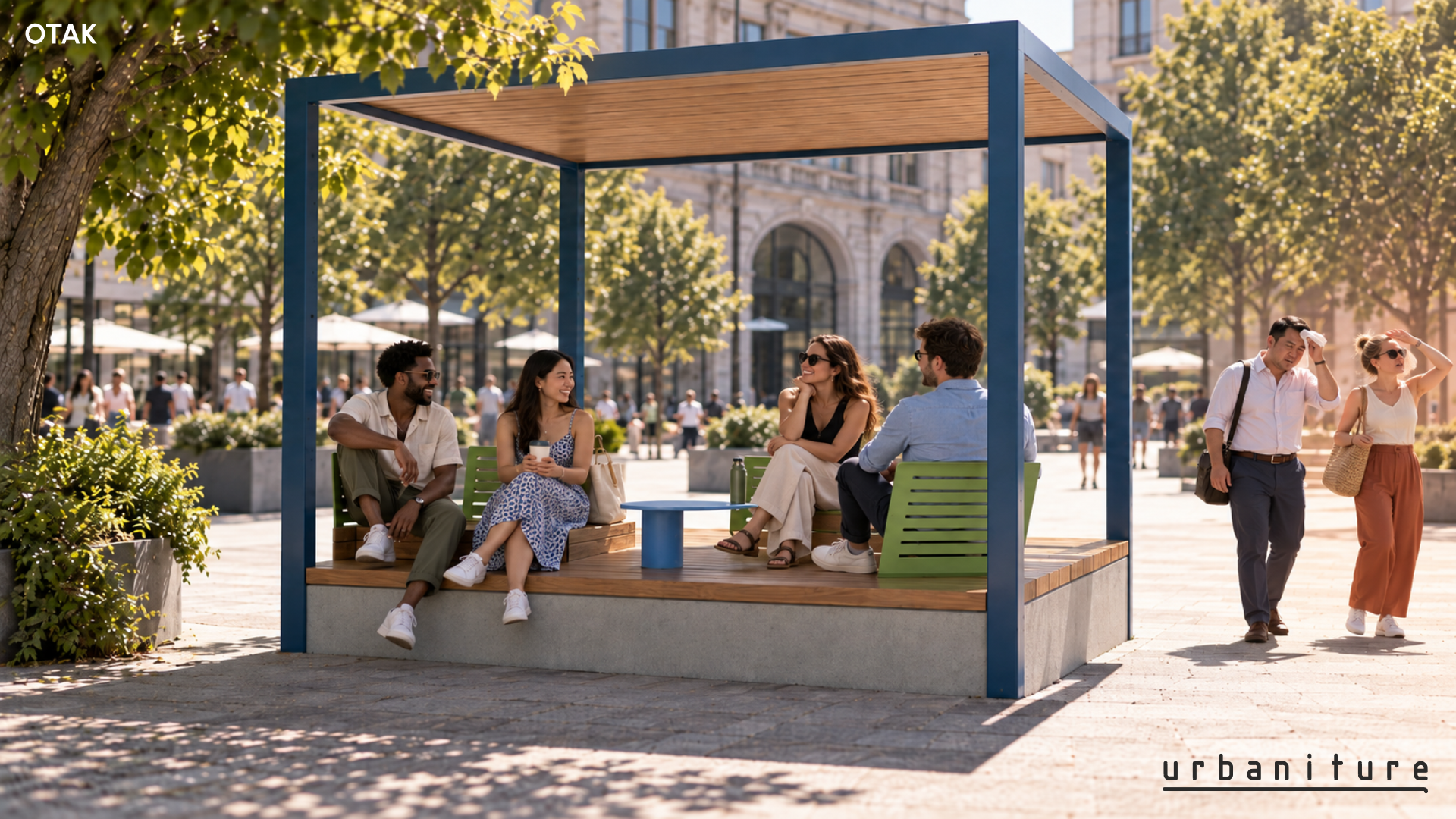
This is where urban furniture, landscape and architecture should operate as complementary layers. A pergola can provide immediate shade while vegetation matures. A seating structure can support climbing plants. A canopy can protect a waiting area where trees cannot be planted. Modular shade elements can respond to seasonal demand, bridging the years between planting and mature canopy.
The principle matters more than the typology: shade should be treated as a basic public service rather than an optional feature.
Cooling is also a question of access
Heat does not affect everyone equally. Older adults are particularly vulnerable during periods of extreme heat. Children can be more susceptible during prolonged exposure. People with chronic health conditions, limited mobility, outdoor occupations or little access to cooled private environments may also face greater risks.
This makes thermal comfort a question of equity as well as climate performance.
A city can contain excellent shaded parks and still provide inadequate protection if reaching them requires a long walk through exposed streets. Climate adaptation therefore cannot depend only on destination spaces. It also requires a distributed network of everyday thermal refuge: shaded seats along pedestrian routes, comfortable transit stops, drinking fountains near playgrounds, resting places between housing and local services, and sheltered seating close to healthcare or community facilities.
Here climate adaptation and inclusive design converge. A bench intended to support an older person during a hot day needs more than shade. Backrests and armrests can make sitting down and standing up easier. Seat height, clear transfer space and room for wheelchairs, prams and mobility aids all affect who can actually use a rest point. The distance to the next shaded seat may determine whether independent movement remains possible during a heatwave.
These are not separate design conversations. For someone trying to move independently through a city during extreme heat, they are part of the same experience.
Climate-resilient public space therefore needs to be designed not for an abstract average user, but for different bodies, different abilities and different levels of thermal vulnerability.
Trees, water and furniture as one system
Climate adaptation is often separated into categories: green infrastructure, blue infrastructure, mobility, street furniture and public-space design. People, however, experience one environment.
Urban furniture can therefore act as an interface between ecological systems and everyday human use.
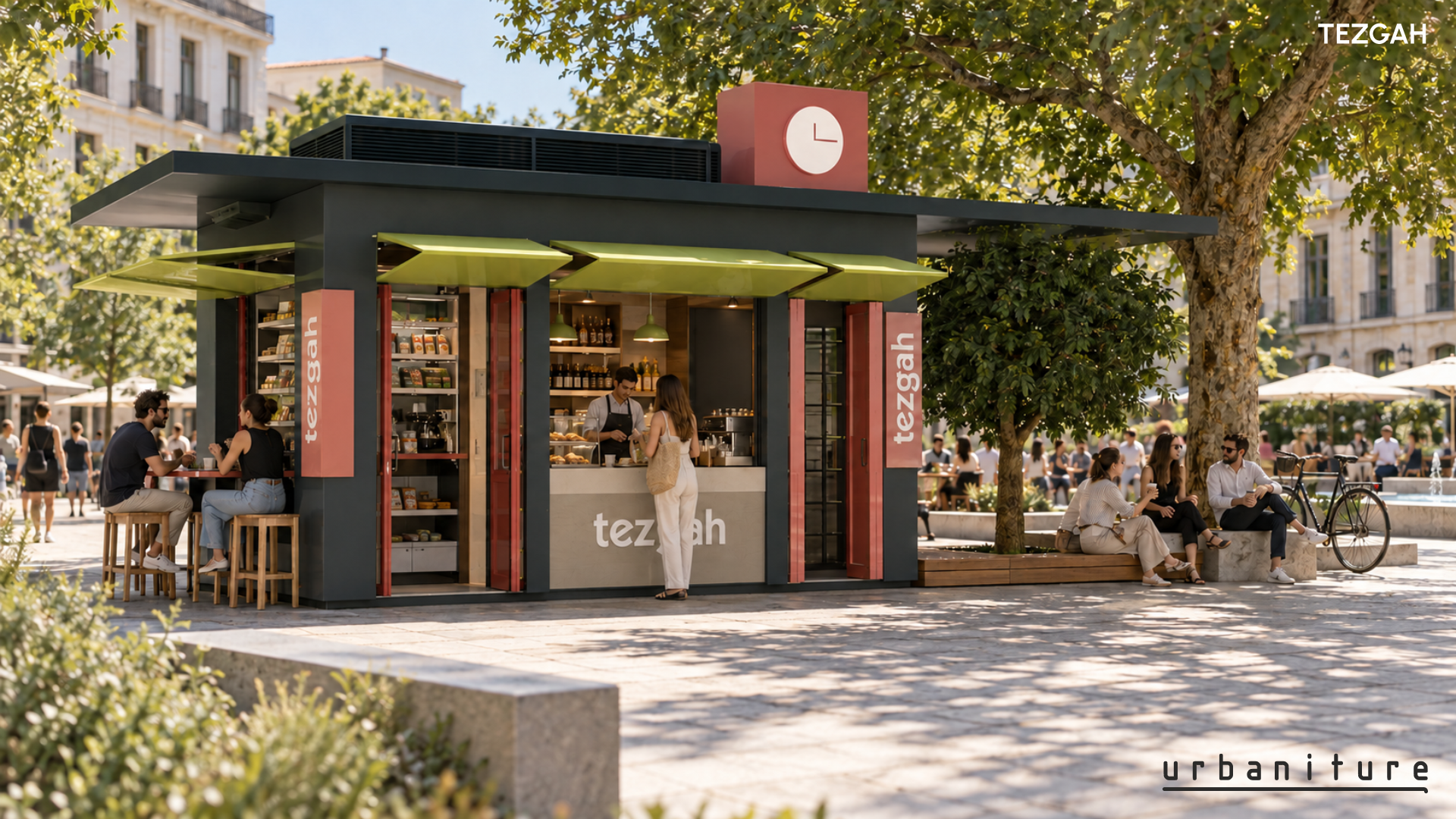
A bench surrounding a tree can provide rest and shade while helping protect the root zone from compaction. A planted seating element can introduce vegetation into a hard-surfaced environment. A rain garden framed with seating can make stormwater infrastructure part of public life rather than something hidden from it. A shade structure can potentially collect rainwater for nearby planting. A bicycle stop can combine parking with seating, shade and access to drinking water.
The ground plane matters as much as the object placed on it. A thermally considered bench surrounded by dark, impermeable paving can still sit within an uncomfortable radiant environment. Reducing sealed surfaces and introducing permeable paving, planted ground or open soil where conditions allow can therefore reinforce the cooling performance of furniture while supporting stormwater infiltration and a healthier local water cycle.
The objective is not to attach as many functions as possible to every object. Multifunctionality is valuable only when the functions reinforce one another. The larger ambition is to replace a collection of unrelated objects with a coherent environmental system.
Planters require particular care in this discussion. Container planting can bring vegetation into places where open ground is unavailable, but it should not be presented as equivalent to healthy in-ground planting. Restricted soil volume limits tree size and longevity, while irrigation and maintenance requirements increase.
Planters are therefore often best understood as complementary infrastructure — valuable where conditions demand them, but not a substitute for sufficient soil, water and long-term tree canopy.
Water returns to the public-space brief
Drinking fountains and water infrastructure are frequently treated as secondary elements rather than part of the core urban furniture programme. Hotter public spaces make that separation increasingly difficult to justify.
Accessible drinking water is one of the simplest and most direct forms of climate adaptation. Refill points support walking, cycling, play and everyday mobility at exactly the moments when exertion and heat combine.
Water can also play a broader environmental role. Rainwater can support planting rather than being removed immediately from a site. Permeable areas beneath furniture zones can help water return to the ground. Planters can connect to stormwater collection. Seating can frame rain gardens and bioswales. Shade structures may, where appropriate, contribute to rainwater capture.
Evaporative cooling can also improve outdoor thermal comfort under suitable conditions. Research on misting systems suggests that meaningful comfort improvements are possible, particularly when misting is combined with shade. Performance, however, depends strongly on humidity, airflow, system configuration and local climate.
Where misting is used, cooling performance must be matched by rigorous water-management and maintenance protocols. Aerosol-generating systems can create public-health risks when warm or stagnant water is poorly managed, making temperature control, regular flow, cleaning and appropriate system maintenance part of the design responsibility.
These qualifications matter. Climate-responsive design should not become a catalogue of technical features. Water is limited, systems require maintenance, poor drainage can create new problems, and planting without reliable water may fail exactly when cooling is most needed.
The better approach is to design water as a cycle: capture, retain, use, drain and reuse where appropriate. Urban furniture can participate in that cycle rather than simply being placed on sealed pavement.
Material intelligence over material fashion
There is no universally perfect climate-resilient material.
Metal can offer structural efficiency, durability and recyclability while becoming uncomfortable — or, under some conditions, unsafe — as an exposed contact surface in strong sun. Concrete and stone can provide long service life and structural robustness but may store substantial heat and release it later. Timber often provides a different tactile experience and lower thermal conductivity at the point of contact, while introducing questions of sourcing, weathering, detailing and maintenance.
Polymers and composites may perform well in some thermal and maintenance scenarios while creating different challenges around ageing, repair and end-of-life separation. Colour, surface finish and geometry also matter. Dark surfaces generally absorb more solar radiation, while highly reflective surfaces can reduce absorption but may redirect glare and radiant energy towards nearby users.
Climate-responsive material selection therefore requires several performances to be evaluated together:
| Design priority | Urban-furniture implication |
|---|---|
| Thermal usability | Evaluate contact surfaces under summer solar exposure and avoid uncomfortable heat transfer where users sit or touch. |
| Low embodied impact | Use recycled, renewable or lower-carbon materials where they meet functional and durability requirements. |
| Repairability | Design replaceable slats, panels, supports and fixings instead of forcing whole-product replacement. |
| Long service life | Specify robust construction, maintainable finishes and details suitable for intensive public use. |
| Circularity | Prefer assemblies that can be separated at end of life rather than permanently bonded material combinations. |
| Adaptability | Use modular systems that can be extended, reconfigured or relocated as conditions change. |
Microclimatic performance should also be considered against lifecycle impact. Adding electronics, pumps, photovoltaic components or advanced coatings may improve local performance while increasing embodied carbon, maintenance requirements and replacement complexity. The climate value of an intervention therefore depends not only on what it achieves during use, but also on how it is manufactured, maintained, repaired and eventually disassembled.
A material is not sustainable simply because it looks natural, nor is a product climate-resilient simply because it contains recycled content. The stronger measure is whether the furniture remains comfortable, durable, repairable, adaptable and useful over time.
Passive before active
Technology is becoming increasingly common in urban furniture. Environmental sensors can record temperature, digital information can communicate warnings, solar systems can support lighting and charging, soil-moisture monitoring can help manage planting, and usage data can reveal whether people are avoiding particular spaces during extreme heat.
These tools can be valuable, but a bench does not become climate-adaptive because it contains a sensor, and a shelter does not become comfortable because it contains a screen.
The design hierarchy should remain physical: shade before cooling equipment, orientation before sensors, airflow before mechanical intervention, vegetation before decorative technology, and material behaviour before digital intelligence.
Technology adds the most value once these fundamentals have been resolved. Often, the smartest object is the one that achieves comfort with the least energy, maintenance and technical complexity.
Modularity turns adaptation into a process
Neither climate nor public life is static. Heatwaves, heavy rainfall, drought, seasonal vegetation, events and changing patterns of use all affect how outdoor space performs.
This makes fixed solutions designed around an assumed average day increasingly difficult to defend.
Modular urban furniture offers another approach. Shade elements can be installed seasonally. Seating can move as patterns of shade change or trees mature. Planters and benches can be reconfigured. Temporary cooling elements can appear during exceptional heat. Damaged components can be replaced individually instead of discarding an entire system.
Most importantly, modularity allows cities and designers to test before committing. A configuration can be installed, observed and measured. User behaviour can be studied. Thermal conditions can be compared. Elements can then be repositioned, modified or improved.
Testing does not need to begin only after installation. Microclimate simulation can compare shade geometry, material behaviour, ground surfaces and solar exposure during the design stage, allowing alternatives to be evaluated before they become permanent infrastructure. Simulation does not replace observation or field measurement, but it can make the design process more informed and iterative from the outset.
Climate resilience becomes an iterative design process rather than a one-time specification exercise.
From furniture catalogue to climate network
Perhaps the most important change is procedural.
Urban furniture often enters projects too late. Architecture is largely resolved, landscape has been designed, circulation is fixed and utilities have been coordinated. Only then does the furniture schedule appear: benches, bins, bicycle racks, bollards, planters, shelters and drinking fountains.
That sequence makes it difficult for urban furniture to contribute meaningfully to climate performance.
If seating, shade, planting, water, accessibility and movement are interconnected, they need to be considered together — and considerably earlier.
The urban furniture design brief itself must evolve.
For municipalities, architects, landscape architects and developers, the brief can therefore begin with a more strategic set of questions:
- Shade: When is each seat or waiting point shaded during the day and across the seasons?
- Surface behaviour: How do contact surfaces perform under direct summer solar exposure?
- Water: Is drinking water accessible along everyday routes, and can rainwater remain useful within the landscape?
- Vegetation: Does planting have enough soil, water and protection to survive future conditions?
- Inclusion: Can older people, wheelchair users and people with limited stamina move comfortably between resting points?
- Extreme weather: Does the element continue to function during heat, drought and heavy rainfall?
- Lifecycle: Can components be repaired, replaced, modified or relocated rather than forcing complete product replacement?
These are not optional sustainability features. They are becoming performance criteria for public space.
The bench as climate infrastructure
Climate adaptation will not be achieved through one spectacular park, one technological prototype or one landmark cooling installation. It will also depend on thousands of smaller decisions distributed throughout the public realm.
Where can someone sit? Will that seat be shaded when it is most needed? Can its surface be touched comfortably? Is drinking water nearby? Can an older person stand up easily? Can a wheelchair user stop alongside it? Can vegetation survive? Can rainwater remain in the landscape? Can the furniture adapt as conditions change? Can a damaged component be replaced without discarding the whole object?
Individually, these decisions appear minor. Collectively, they determine whether public space continues to function under increasingly demanding climatic conditions.
That is why urban furniture matters. It operates precisely where large climate strategies meet the human body.
The next generation of climate-adaptive urban furniture should therefore do more than furnish the city. It should help public space remain comfortable, accessible, adaptable and inhabitable.
A bench should still invite people to sit. A fountain should still invite them to drink. A tree should still give character to a street. A canopy should still create a place beneath it.
Together, however, these ordinary elements can perform an increasingly important task: helping public life continue in a hotter world.
The Urbaniture perspective
At Urbaniture, we approach urban furniture as a human-scale system: the layer of public space where people sit, wait, move, meet, find shelter and access everyday services.
As climatic conditions change, that layer must become adaptive as well. Thermal comfort, inclusion, ecology, water, material intelligence, repairability and modularity should not be added to public-space furniture after the principal design decisions have already been made. They belong in the brief from the beginning.
Because climate-responsive public space is not created by adding more objects. It is created by designing the relationships between people, furniture, shade, water, vegetation and place.
Explore Urbaniture’s approach to urban furniture design.
References
- Dzyuban, Y., Hondula, D. M., Coseo, P. J., & Redman, C. L. (2022). Public transit infrastructure and heat perceptions in hot and dry climates. International Journal of Biometeorology, 66(2), 345–356.
- Middel, A., AlKhaled, S., Schneider, F. A., Hagen, B., & Coseo, P. (2021). 50 Grades of Shade. Bulletin of the American Meteorological Society.
- Silva, T., Matias, M., Girotti, C., Vasconcelos, J., & Lopes, A. (2025). Heat stress mitigation by exploring UTCI hotspots and enhancing thermal comfort through street trees. Theoretical and Applied Climatology, 156, 162.
- Vanos, J. K., Wright, M. K., Kaiser, A., Middel, A., Ambrose, H., & Hondula, D. M. (2022). Evaporative misters for urban cooling and comfort: effectiveness and motivations for use. International Journal of Biometeorology, 66(2), 357–369.
- University of Bern. (2023). Global warming caused 60 percent of Swiss heat deaths in the summer of 2022.
- ISO 13732-1. Ergonomics of the thermal environment — Methods for the assessment of human responses to contact with surfaces — Part 1: Hot surfaces.
- Nicholson, S., Nikolopoulou, M., Watkins, R., Löve, M., & Ratti, C. (2024). Data driven design for urban street shading: Validation and application of Ladybug Tools as a design tool for outdoor thermal comfort. Urban Climate, 56, 102041.
- Centers for Disease Control and Prevention. (2025). Controlling Legionella in Other Devices.